
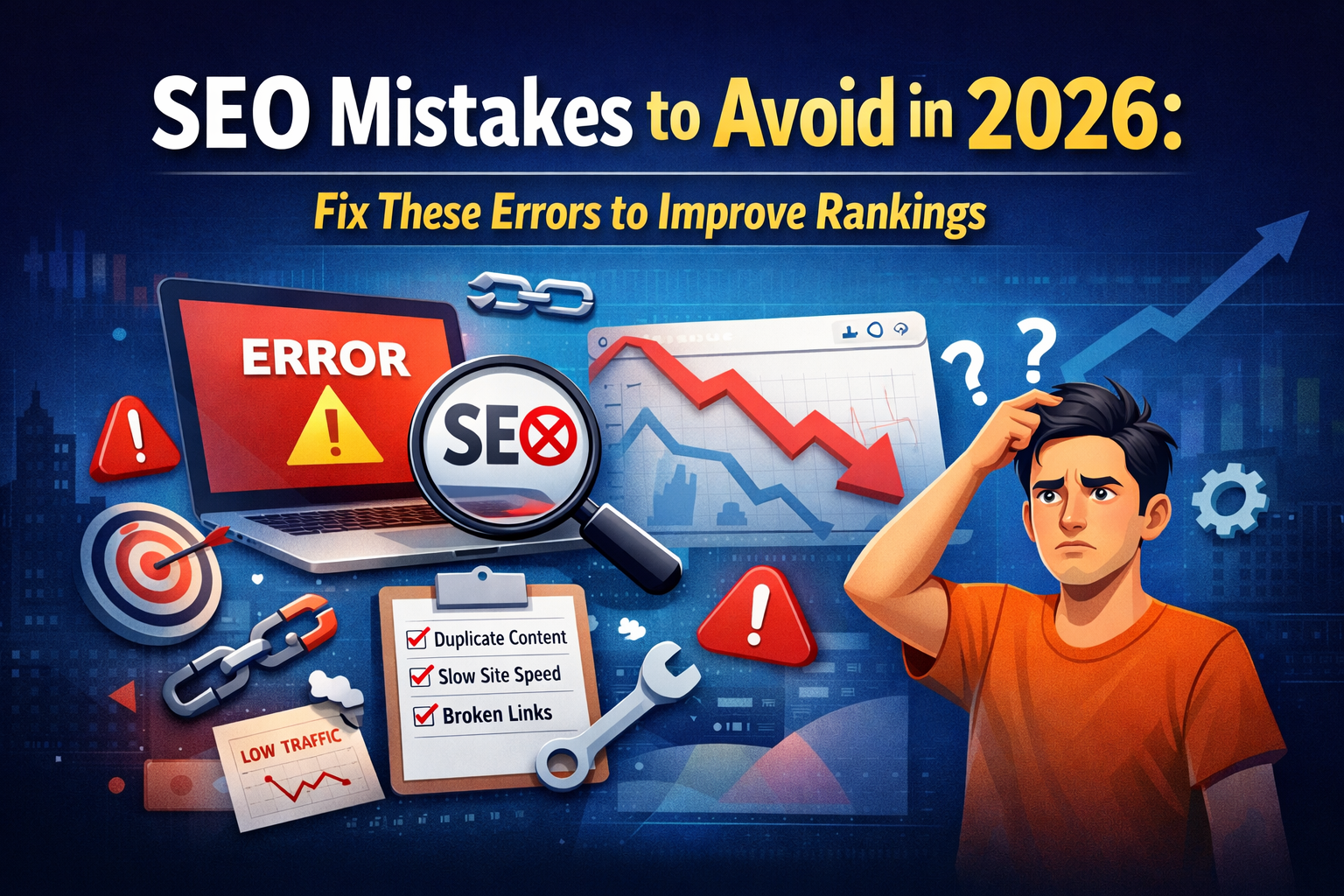
SEO Mistakes to Avoid in 2026: Fix These Errors to Improve Rankings
27
Mar 2026
You may have heard that if you’re currently ranking your site for anything recently then “SEO is not as good anymore.”. Even what used to work last year could be silently hurting you today. The Google brain got bigger; our attention span shrunk to nanoseconds; there’s no room left for mistakes.
Let's discuss SEO mistakes to avoid in 2026 - not from a technical standpoint, but rather as if we're trying to figure it out together. Honesty is that many do not fall short on their efforts for search engine optimization (SEO) but rather from making minor errors repeatedly and consistently.
1. Writing for Search Engines Instead of People
This one is still the biggest trap.
Articles filled to brim with keyword stuffing, clumsy writing style as well as unnatural sounding phrases. They may get some rankings momentarily; however, they don’t last long.
In 2026, Google will be very focused on user satisfaction signals, how long users stay, do they bounce, etc. and are they getting value out of it.
Your writing sounds artificial and readers will walk away from it. When members go away ratings fall off.
Fix it:
Write like you talk. Explain things simply. Do not use this phrase if your text reads awkwardly aloud.
2. Ignoring Search Intent (This One Hurts Rankings Fast)
You can have the best-written article in the world, but if it doesn’t match what the user wants… it won’t rank.
For example:
- Someone searching “best SEO tools” wants a list
- Someone searching “what is SEO” wants a simple explanation
- Someone searching “buy SEO services” wants a service page
If you mismatch intent, Google won’t trust your page.
Fix it:
Take some time before starting to write; ponder these questions first:
“What is the user really trying to get here?”
Then build your content around that — not around what you want to write.
3. Over-Optimizing Keywords
There was a time when repeating your keyword 20 times worked. Not anymore.
Now, overusing your keyword like “seo mistakes to avoid 2026” in every paragraph can actually harm your content quality.
Context is understood by Google more now, really well.
Fix it:
Use your keyword naturally:
- In the title
- In the first paragraph
- In a few headings
- A couple of times in the body
After that, let it flow naturally. Use variations and related terms.
4. Publishing Thin Content Just to Stay Active
A lot of people think consistency means posting daily, no matter what.
So they publish:
- 500-word shallow articles
- Rewritten content with no value
- Generic advice already everywhere
This doesn’t build authority — it weakens it.
Fix it:
Prioritize quality above quantity. A great article is better than five terrible ones by a landslide.
Ask yourself :
“Would I actually bookmark or share this?”
If not, it needs improvement.
5. Forgetting About User Experience (UX)
Your site may be full of good material …but it’s likely to turn people away with its irritating design, sluggish speed and unclear layout.
Common UX mistakes:
- Slow loading pages
- Too many popups
- Hard-to-read fonts
- No clear structure
Google notices when users struggle.
Fix it:
Make your site feel easy:
- Clean layout
- Fast loading
- Clear headings
- Mobile-friendly design
Consider that as well; if your website is too much for them to handle they will go away.
6. Not Updating Old Content
This is one of the most underrated SEO mistakes.
You publish an article… it ranks… and then you forget about it.
Meanwhile, competitors update their content, add new information, and slowly outrank you.
Fix it:
Go back to your old content every few months:
- Update stats
- Improve sections
- Add new insights
- Refresh examples
Google loves freshness — especially when it improves quality.
7. Weak Internal Linking
Internal linking isn’t just about SEO — it’s about guiding your reader.
Without it:
- Users leave quickly
- Pages stay isolated
- Authority doesn’t flow across your site
Fix it:
Link naturally to relevant pages within your content.
For example:
If you mention keyword research, link to your detailed guide on it.
It helps both:
- Users (they explore more)
- Google (it understands your site structure)
8. Chasing Backlinks the Wrong Way
Backlinks still matter. But the way you build them has changed.
Spammy tactics like:
- Buying low-quality links
- Comment spam
- Irrelevant guest posts
…can now hurt more than help.
Fix it:
Focus on earning links, not forcing them:
- Write genuinely useful content
- Reach out to relevant websites
- Build real relationships
Quantity is never better than quality, ever.
9. Ignoring Mobile Optimization
This isn’t optional anymore.
A lot of people browse websites from smartphones while Google is doing mobile first indexation.
If your site looks bad or loads slowly on mobile… you’re losing rankings and traffic.
Fix it:
Check your site on your phone:
- Is text readable?
- Are buttons easy to click?
- Does it load fast?
If it feels frustrating, fix it immediately.
10. Not Building Topical Authority
In 2026, ranking isn’t just about one article — it’s about how much depth you have on a topic.
If you write one SEO article and expect to rank long-term, it’s tough.
Google prefers websites that cover a topic deeply.
Fix it:
Instead of random posts, build clusters:
- Main guide (pillar content)
- Supporting articles (related topics)
This shows Google:
“This site really knows its stuff.”
11. Writing Without Real Experience
Here’s something people don’t talk about enough.
Content that feels generic usually is generic.
Google is getting better at identifying real experience vs surface-level writing.
Fix it:
Add your personal touch:
- What worked for you
- What failed
- What you learned
Even small real insights make your content stand out.
12. Expecting Instant Results
This might be the hardest truth.
SEO takes time. Sometimes weeks. Often months.
Too many give up way to soon as there are no fast wins.
Fix it:
Stay consistent. Keep improving.
Think long-term:
SEO is not a quick win — it’s a compounding asset.
Final Thoughts (Real Talk)
If you look closely, most SEO mistakes to avoid in 2026 aren’t about technical tricks.
They’re about:
- Understanding people
- Creating real value
- Being patient and consistent
It changes constantly though something remains constant is:
Helpful content wins.
So instead of trying to “game” SEO, focus on doing it right.
Because when you align with what users actually want… rankings follow naturally.

Comments
No comments yet.